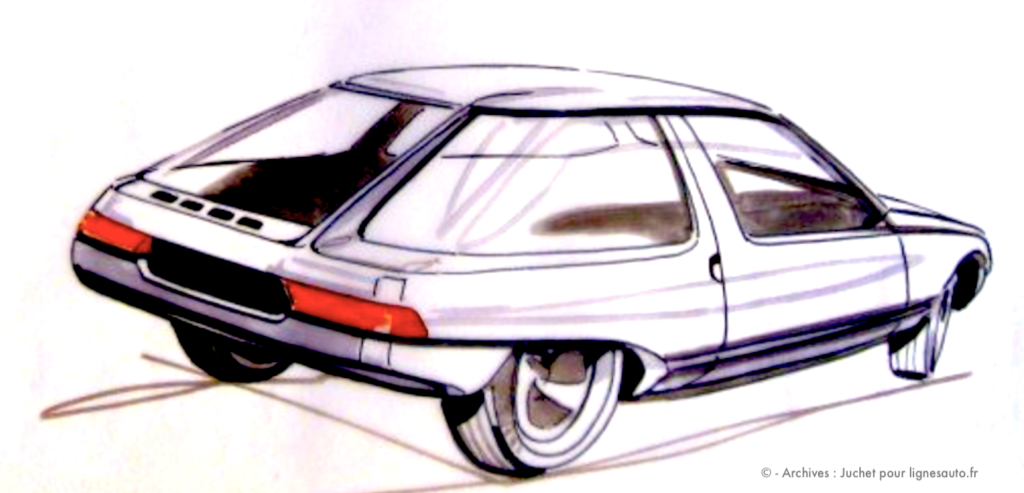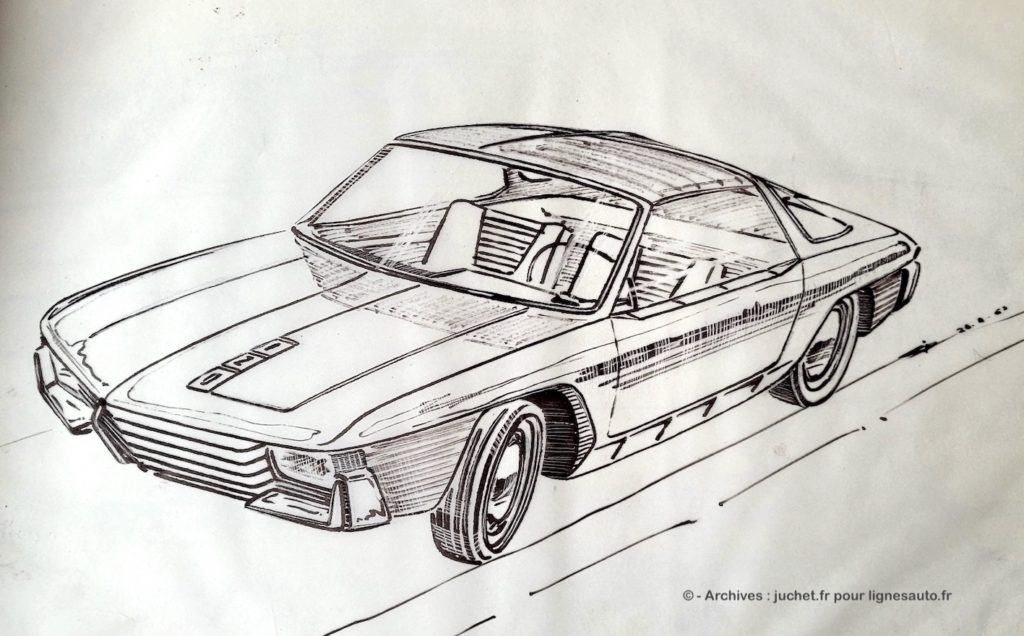
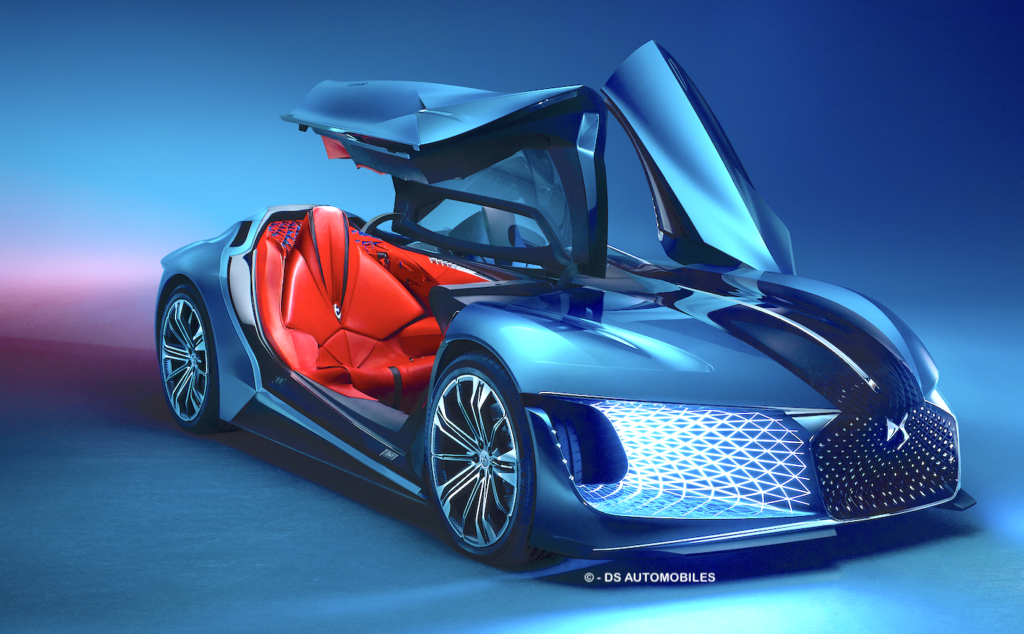
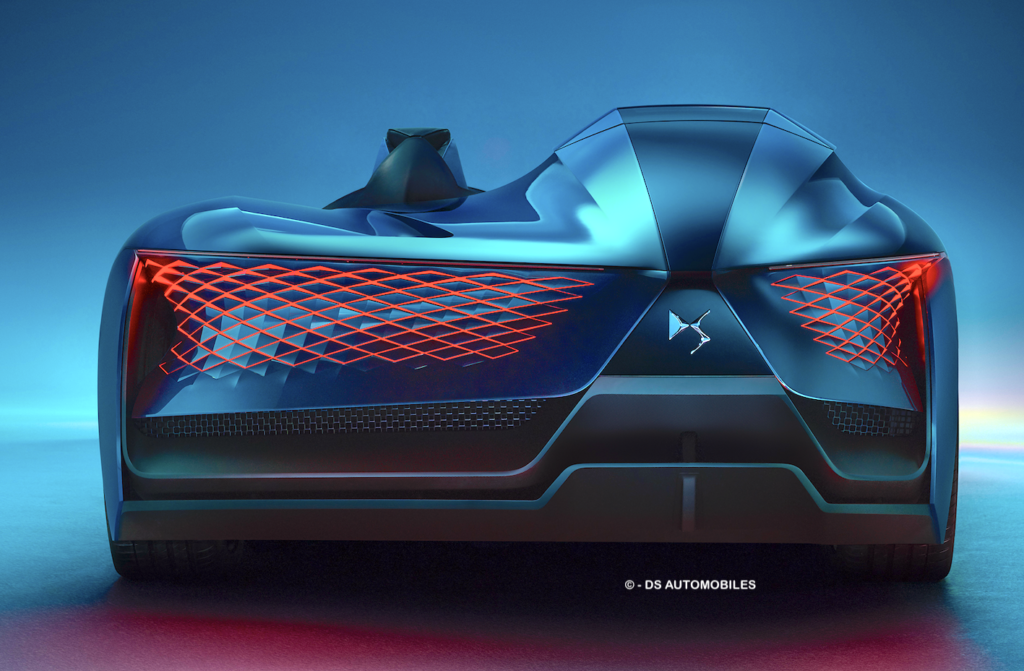
The theme of asymmetry in the world of automotive design is not new. The latest brand to have worked with it in an extreme way is DS Automobiles with its X E-Tense concept car unveiled in 2018. Why does asymmetrical design so rarely make it past the prototype stage? Yet it could create an effect of originality, even dynamism. We have unearthed a few projects on this original theme by Gaston Juchet, who was head of design at Renault, where he designed and managed his teams from 1960 to 1987.
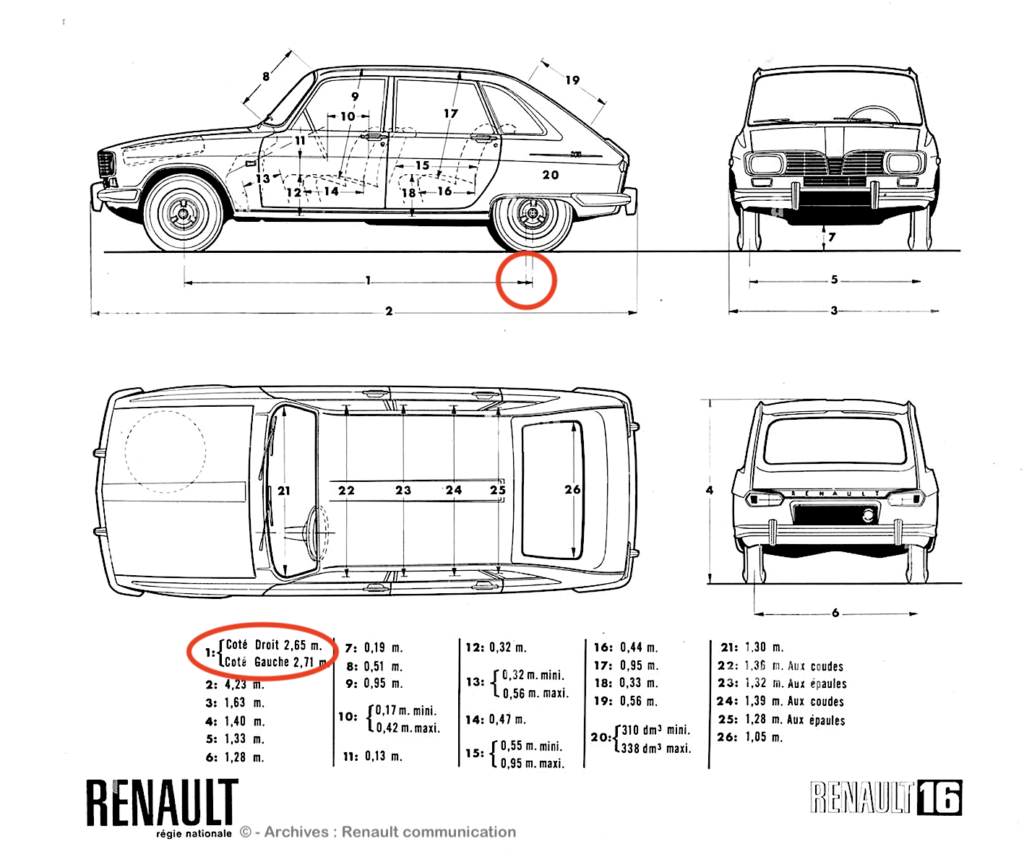
In terms of functionality, asymmetry has often been the result of adventurous technical architecture. One example that comes to mind is the torsion bar suspension on the Renault 4, 5, 6 and 16 models below, which requires two different wheelbases on the R16, one on the left (2.717 m) and one on the right (2.650 m), and therefore specific body sides. However, there is no deliberate stylistic effect here, as the styling is not impacted.
Before discussing Gaston Juchet’s projects (one of the masters of asymmetrical design, as we shall see), which combine both functionality AND aesthetics, let us pause for a moment to consider the functional aspect alone: the doors. Asymmetry in this area is more common, whether in production models or in the form of concept cars or abandoned projects.
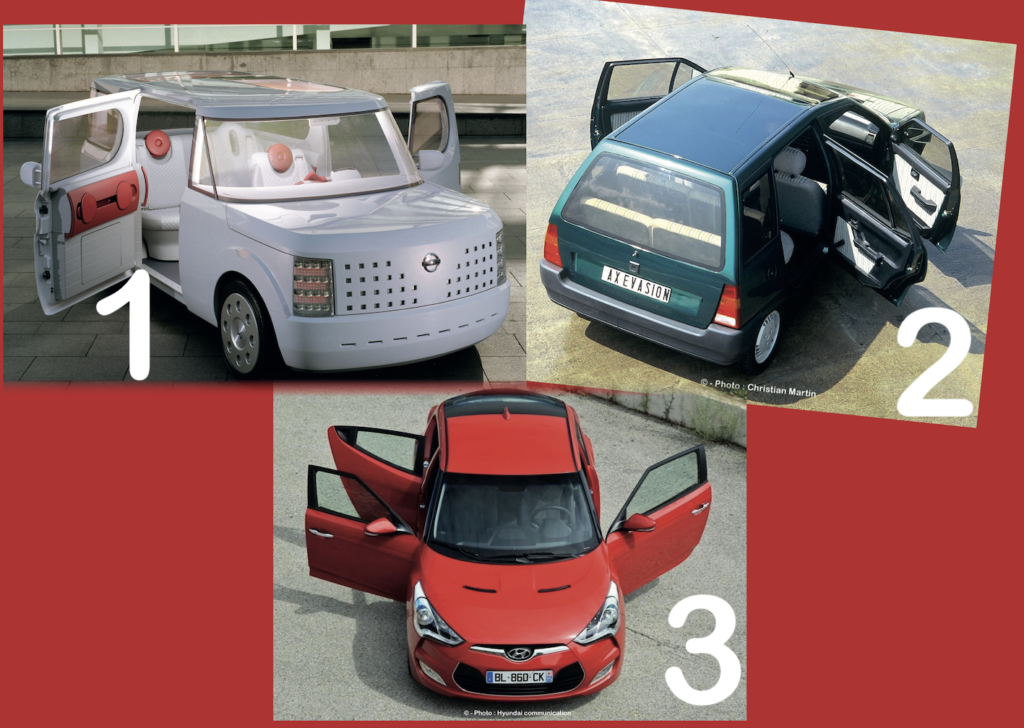
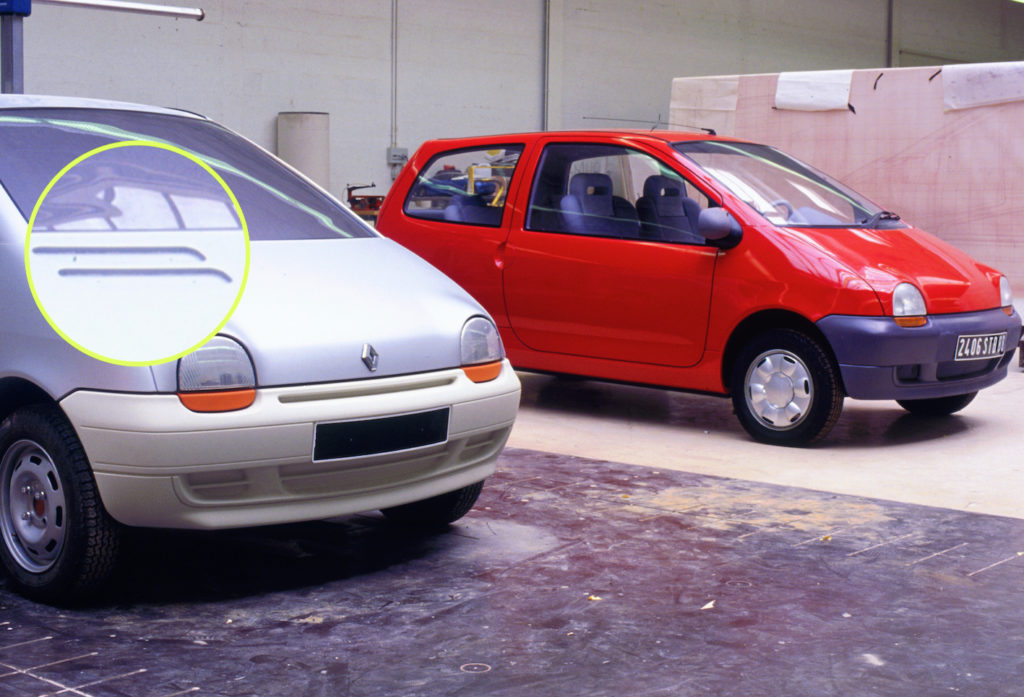
Asymmetry also plays a role in identity at little cost, as it involves moving a brand logo from its usual place in the centre to the edge of a bonnet or grille. This was particularly fashionable in the 1980s. Another example of this identity-building technique is the Renault Twingo (1992) with its double air intake offset on the bonnet. This styling idea was copied exactly by Peugeot on its 206, launched five years later.
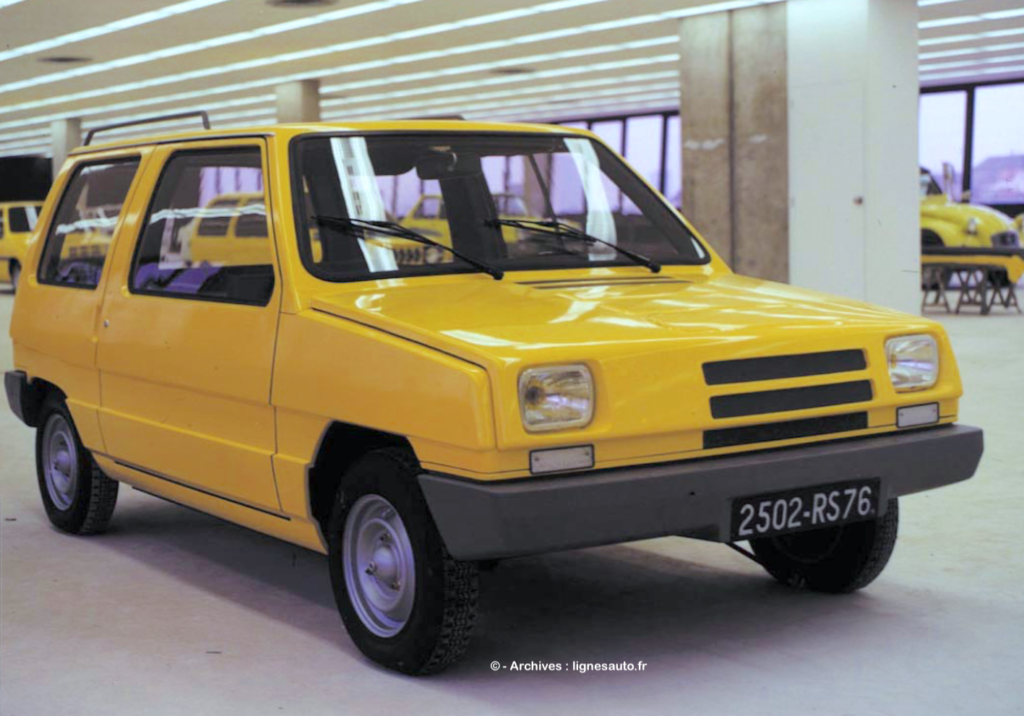
Along with the logo, the grille was sometimes offset, as on the 1980 Panda – to the right or left on the latter, depending on the engine type – or on this 1976 study by Gaston Juchet (below) for the VBG (Véhicule Bas de Gamme) programme. The asymmetry in this case is limited and may be due to technical considerations, such as the engine cooling radiator being offset in the front block. It should be noted that this programme was to feature a brand new three-cylinder engine.
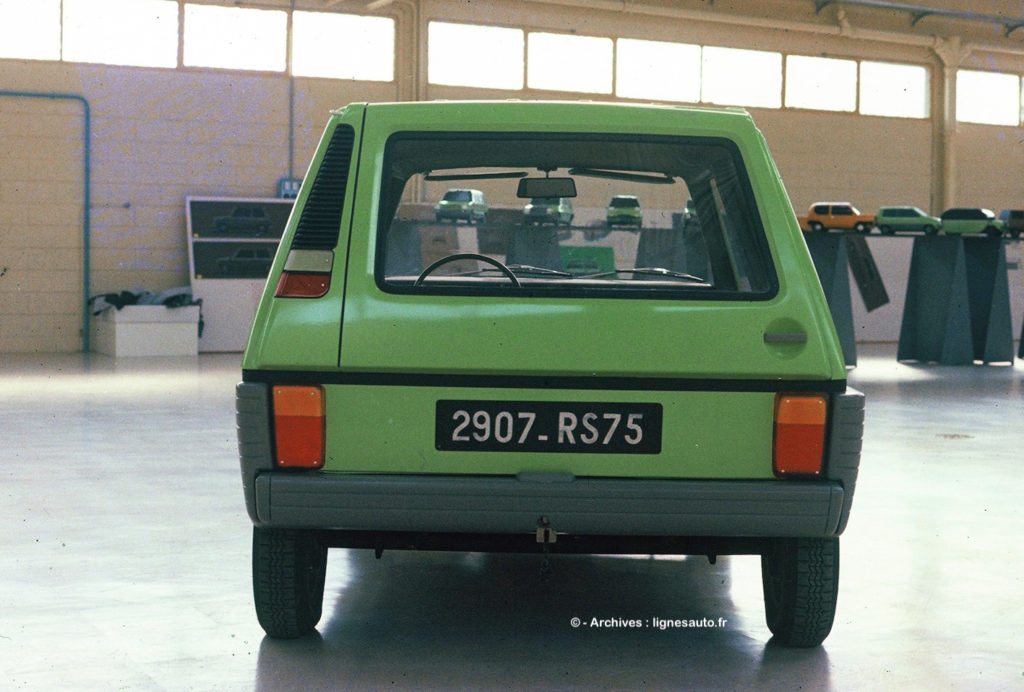
Almost a year before his proposal above, Gaston Juchet had created a fully asymmetrical 1:1 scale model (green model below) in its rear section. A large boot door opened from right to left and was slightly offset to the right of the vehicle. This left room for a ventilation grille for the passenger compartment and for the reversing lights and fog lights on the left side of the rear. Note the round door handle and the fairly high boot sill.
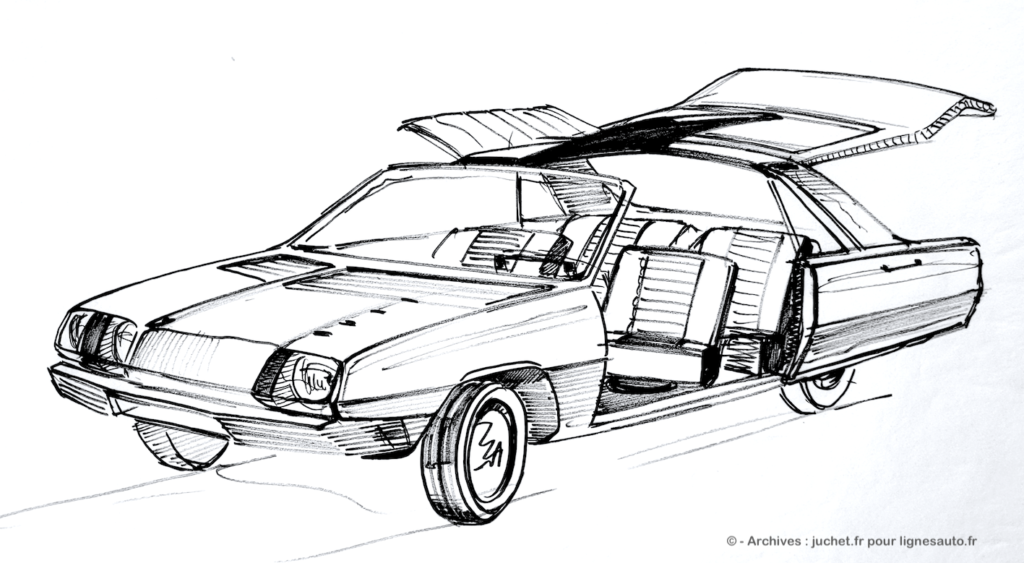
This VBG programme has seen many variations, but Gaston Juchet often added innovations such as the asymmetry of the doors: the side door is a ‘swing’ type, while the driver has a conventional opening door. The ‘pendulum’ door detached from the bottom of the body and slid along a rail in the roof. There was no B-pillar in this design, which offered generous access to rows 1 and 2.
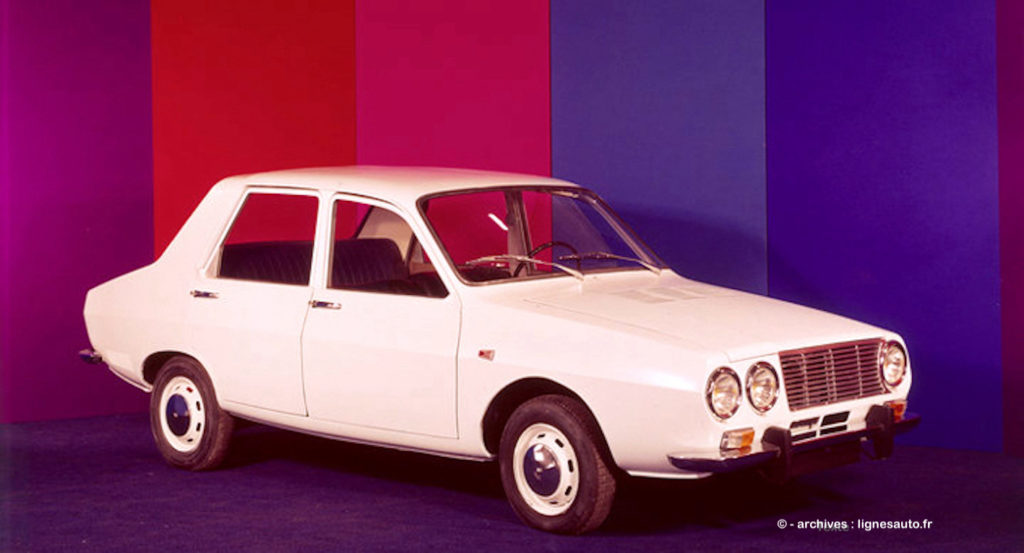
In addition to the doors, asymmetry was also attempted on other stylistic elements, such as the headlights. This was at a time when manufacturers had long been dependent on developments in this ‘accessory’, which was available in a round shape, then a rectangular shape in the early 1960s (Citroën Ami 6), before huge progress was made in this area. In this article, we will discuss the case of the Renault 12 concept car, which went on sale in 1969 (below).
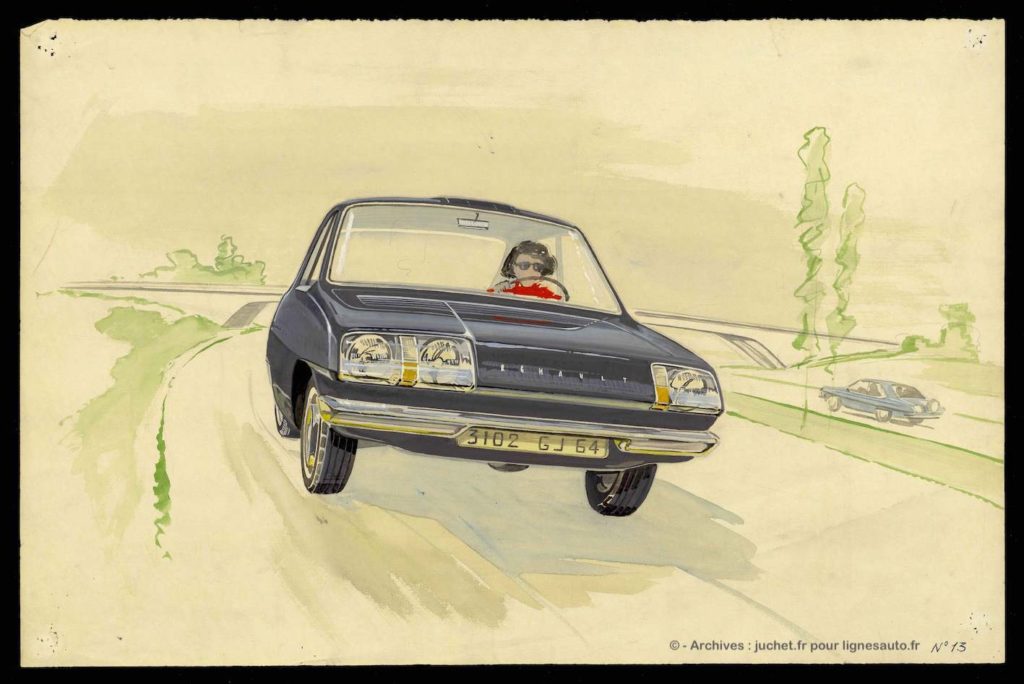
Below is an illustration by Gaston Juchet, recognisable by his signature style: the addition of an architectural element in the form of a modern bridge in the background. This is a study of a saloon car painted before the R12 (date: 1964), which adopts a double headlight on the ‘roadside’ for more effective lighting, and a beautifully executed vertical arrangement of indicators. This asymmetrical headlight design is echoed in the bonnet and the ‘Renault’ lettering logo. Note that the number plate does not follow this movement and is located in the centre of the bumper…
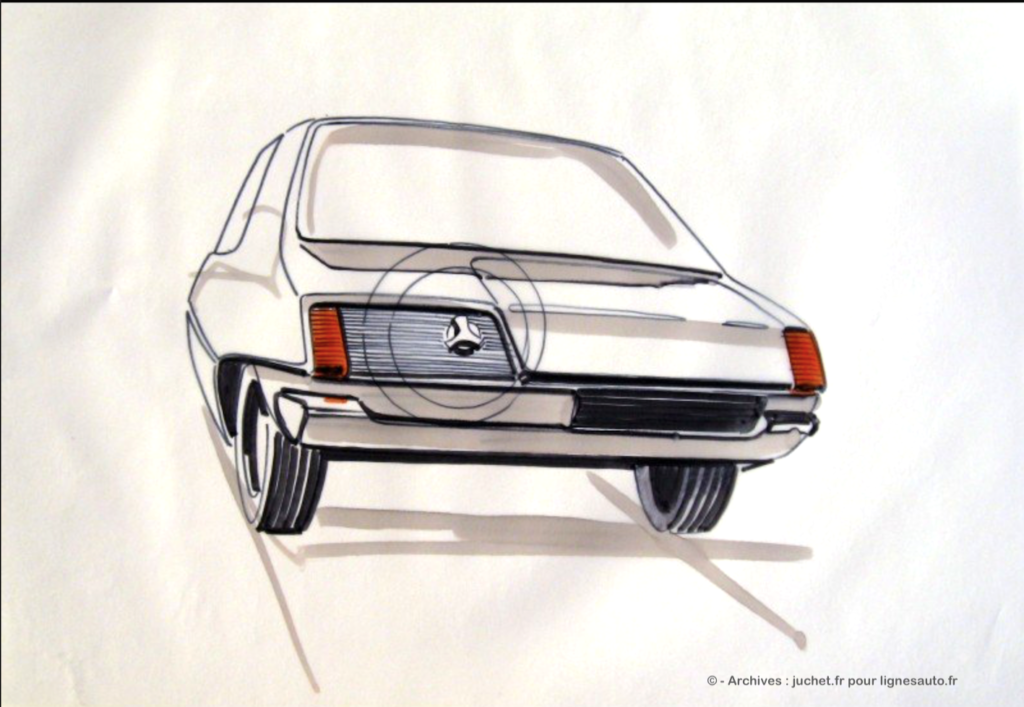
Let us turn to other surprising studies by Gaston Juchet. Below is a rear view of the saloon car design with an asymmetrical boot lid. An anthracite hubcap accompanies the rear left light cluster and houses the fuel cap. Here, the number plate follows the theme of asymmetry by being offset to the far right of the bumper.
Still the same project, below, but this time in a convertible version. Note that the pair of headlights has been moved from the passenger side to the driver’s side, and that the asymmetrical bonnet is much more generous. The Renault lettering has been shifted to the left.
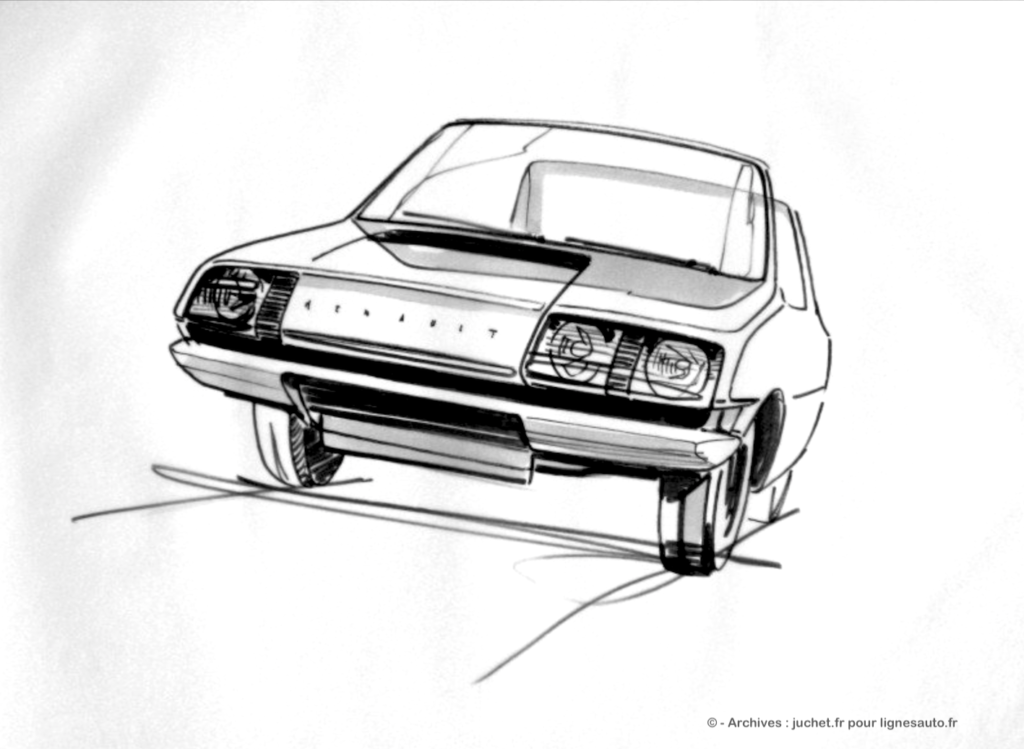
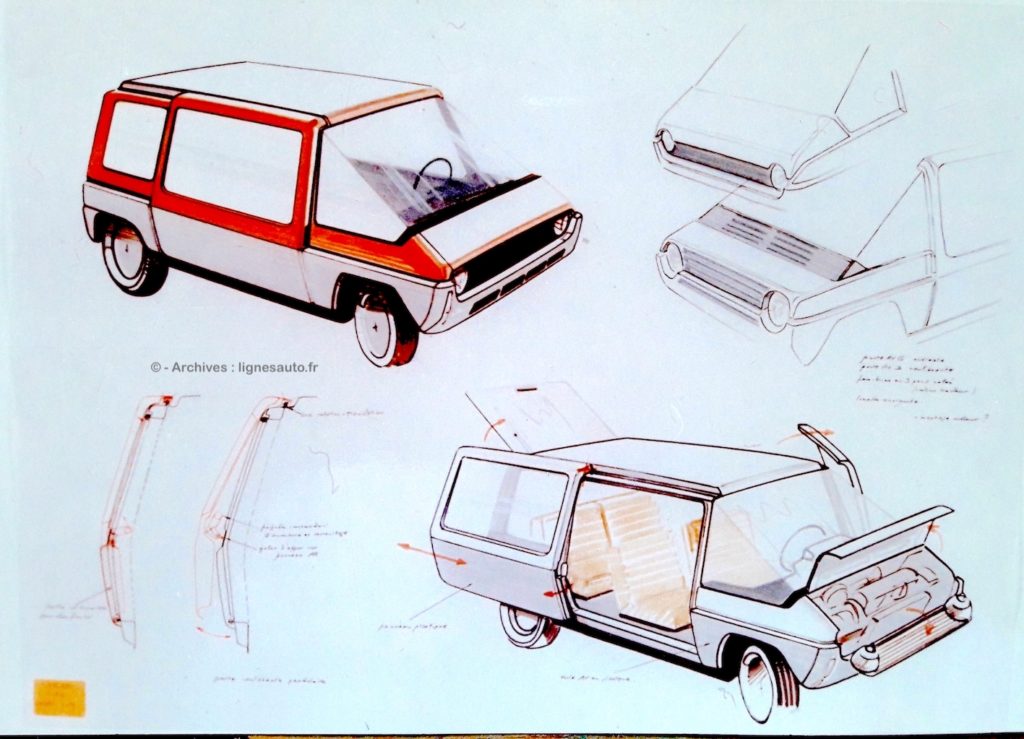
Still based on the same principle of asymmetrical headlights that create asymmetry in the bonnet, this more contemporary study of a small compact car, shown below, clearly features composite bumpers. The bonnet’s embossing has been refined, with a series of louvers on the right that echo the bulge on the left, extending the pair of headlights on the passenger side. The Targa concept for the roof again adopts the principle of asymmetry, while the doors are sliding!
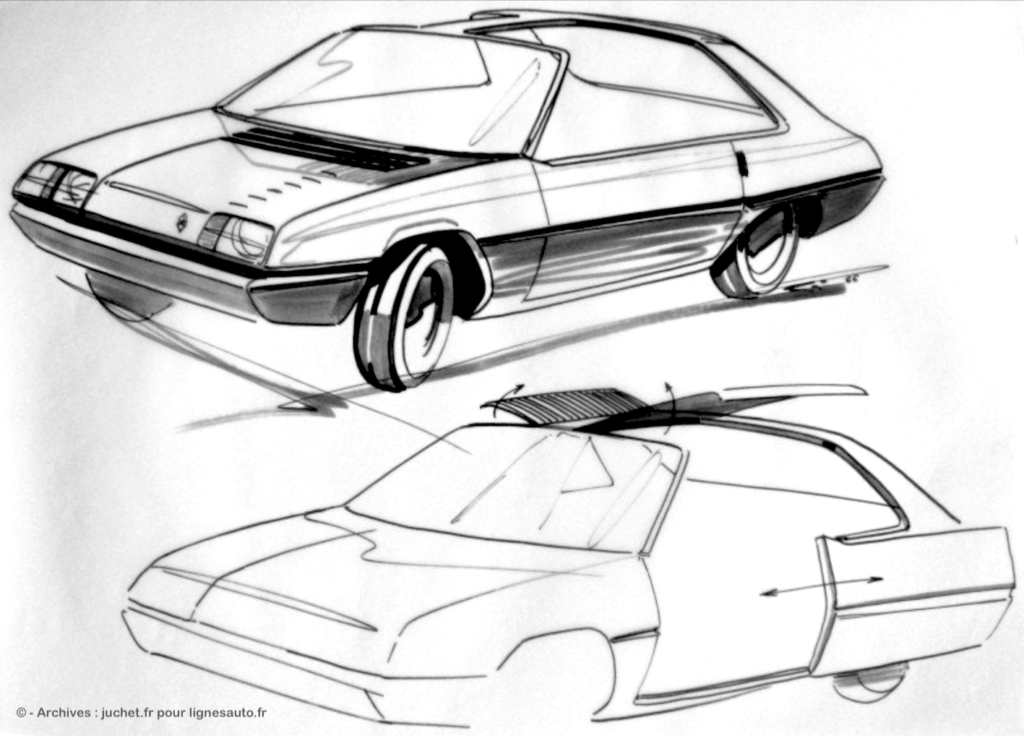
Another drawing from this project below summarises the many innovations in style, architecture and asymmetry conceived by Gaston Juchet. The asymmetry is based on the two headlights on the passenger side (two round headlights, one on the driver’s side). The bonnet features a specific embossed design with small perforated louvers on the right-hand side. The roof lifts up in two asymmetrical sections to improve access to the interior. The doors are sliding with a handle in the centre. The driver’s seat swivels for greater comfort when getting in. And the concept car has a tailgate, an innovative design for a road car, which was industrialised on the R16 in 1965.
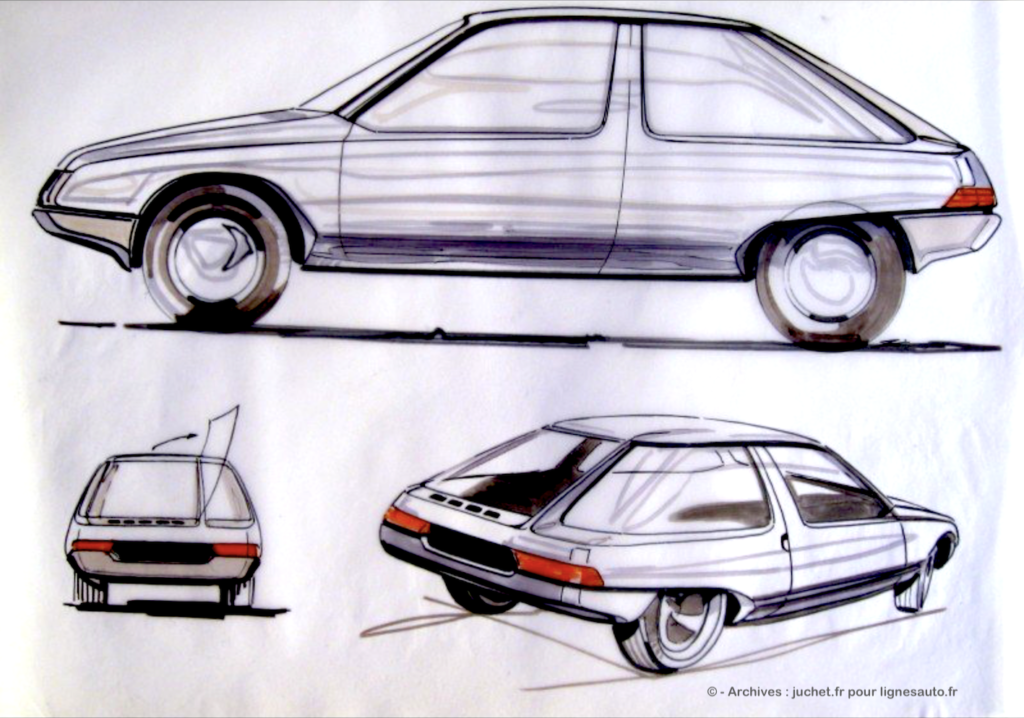
Let’s finish below with a felt-tip pen drawing on tracing paper, which is even more contemporary, of a small compact car. From the side, the asymmetry is not noticeable. At the rear, however, it is striking. On the left side, the side window is classic and rests naturally on the rear pillar. The passenger side window wraps around to the rear third of the car, stopped by a solid pillar that starts at the roof. Here we detect a hint of… Porsche 928! Next to this large glass surface, another glass element opens from left to right to provide (limited?) access to the boot. Four small vents are located below this window.
Today, as we enter the second half of the decade leading up to 2030, it must be acknowledged that asymmetry is absent from current automotive designs. Yet with the advent of electric vehicles and their specific architecture, this concept could have led to a completely new creative approach. Reconciling aesthetic uniqueness with functional needs is a task that asymmetry would be perfectly suited to. It is regrettable that the innovation and distinction it seems capable of is only visible in a few concept cars.
Asymmetry offers numerous design advantages: differentiation in a highly standardised market, specific features that improve access to the vehicle, aerodynamics, and even certain smart adaptations for urban vehicles. Finally, the designer’s vision would enable a real break with the past, giving the project an image of an innovative vehicle. On the other hand, the asymmetrical concept can disrupt the interpretation of the style and, depending on the choices made, increase the cost of industrialisation… Who will dare to revisit this concept of asymmetry in the future?
BONUS: previously unpublished document on an innovative Renault coupé
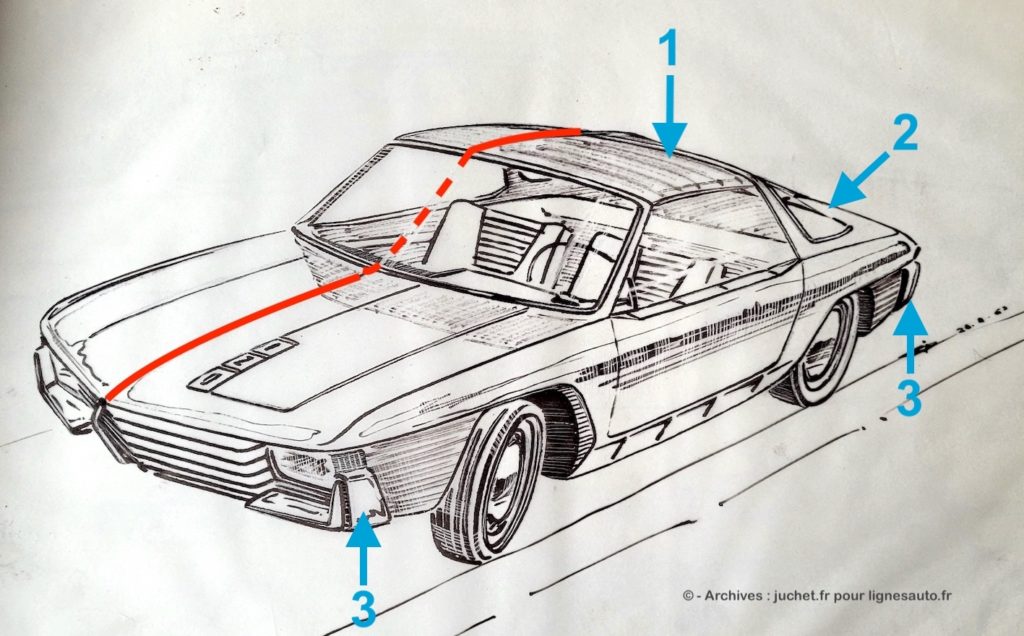
This project dates back to the early 1960s, when the Renault 16 was in its styling freeze phase (launched in 1965). At first glance, it is not obvious that this is an asymmetrical design, which Gaston Juchet was fond of! It is marked ‘120’ on the bonnet, but this has nothing to do with the 120 programme that took shape in 1968 (a large hatchback saloon that, after numerous modifications to the specifications, resulted in the R20/R30 duo). The car below is asymmetrical in terms of its grille, the crease in the bonnet (with the reflection of the windscreen) and its two-part roof, one part of which is probably removable above the driver.
The same design with its specific features shown below: the red line helps to better identify the asymmetry of the project. In 1, the part that is undoubtedly removable, representing two-thirds of the surface area of the roof. In 2, a bubble-shaped rear window. In 3, the bumpers are reduced to their simplest form. The grille is inverted, the headlights are rectangular (a shape recently made available by subcontractors) and the wheel arches are slender. As with all designs of this type by Gaston Juchet, the asymmetry of this design results in an engine bonnet with a stamped finish that creates a deliberate and very distinctive style.
The author would like to thank Jean-Michel Juchet and the Juchet family for making the family archives available. The bilingual book ‘Style Renault 1960-1987, the Gaston Juchet era’ is still available in the three bookshops listed below:
https://www.librairie-passionautomobile.com/produit/style-renault-l-ere-gaston-juchet-1960-1987
https://www.motors-mania.com/fr/tous-nos-produits/10856-style-renault-lere-gaston-juchet-1960-1987.html